People Never Fail At Internet Marketing – They Just Quit Before Success Happens

Browse all the pages, read and understand all the content. Start making real money and change your life.

Affiliate marketing has made businesses millions and ordinary people millionaires.

Browse all the pages, read and understand all the content. Start making real money and change your life.

Business has only two functions - marketing and innovation.

Browse all the pages, read and understand all the content. Start making real money and change your life.

Marketing takes day to learn. Unfortunately it takes a lifetime to master

Browse all the pages, read and understand all the content. Start making real money and change your life.

If you want success, then don't rely on other people to do what YOU can do

Browse all the pages, read and understand all the content. Start making real money and change your life.

NOTE: To prevent any abuse or misuse, you will need to complete a quick survey for some downloads means not all. I know it's kinda annoying, but it's the least you can do. It takes 20-30secs to complete the surveys. It took days for me to make and compile this tools.

Burn ISO Image to CD or DVD


Burn ISO Image to CD or DVD


Ok, I have an ISO file, now what? I can't see the files or folders inside although I copied it to a CD/DVD... Well, an ISO file is an image of a CD or DVD, simply copy it to a CD or DVD as a data file won't be enough. You can think of an ISO image as a "compressed" file. For a CD/DVD ISO, you'll need to burn it out to a blank disc, but with the "image burning" option. Most current burning applications come with this option, and they'll all do the same thing: Extract the files to a temporary location then burn them to CD/DVD.
One big advantage of using ISO image file for CD/DVD is, the image file contains all files/folders and the structure of the CD/DVD, including the hidden sectors, for example, the boot sectors. Some CD/DVD are "bootable", which means you can use the CD/DVD to startup your pc and run some installations or utility. With this kind of CD/DVD, when you view the contents in Windows, you won't see the bootable portion. And when you make a copy of the CD/DVD using the normal method for files, the bootable sectors will NOT be included. However, the Image method will take care of that.
With that said, when you're making a copy of your CD/DVD and you are not sure if the CD/DVD has some hidden contents or bootable sectors, then you better use the ISO image method to make sure everything gets copied.
This page shows you how to burn the ISO image back to CD/DVD, assume that you already have an ISO image is an image created from a CD/DVD.
For instructions how to create an ISO image from a CD/DVD, click Here.
The steps of burning an ISO image to CD/DVD are different depending on which tool you use. However, the following key points should be the same:
  1. Insert a blank CD/DVD.
  2. Open the burning tool.
  3. Select the burning option for ISO/image.
  4. Browse to the ISO/image file.
  5. Burn to CD/DVD.

Detailed Steps
The following sample instructions use Free Easy CD/DVD Burner v1.2. This is a free burning tool with advertising supported, but no spyware or adware. You can download this program from Softpedia, or v4.2 here
  1. If you have not installed a burning program, download the tool above and install it. Make sure to reboot after the installation.
  2. Insert a blank CD/DVD.
  3. Open the Free Easy CD DVD Burner program.
  4. Click on the "Copy CD/DVD" button on the top.

  5. Under the "Action" menu on the left, click the "Burn an image file" link. (Note that if this link is not selectable, then you might have no (or invalid) blank CD/DVD in your drive.)


  6. The window "Select the image file that you want to burn" opens, browse to the ISO file you wish to burn and click "Open".

  7. A dialog box will appear asking "Do you want to burn...", cilck "OK" to confirm.
  8. The burning process will start to extract files and burn to your CD/DVD. This process will take a few minutes depending on the size of the ISO file and the speed of your burner.

Reset Windows Password


Reset Windows Password


Forgot your administrator password? Don't panic, it happens to some other people too, and you have found the solution! The following instructions will show you step-by-step how to reset your local Windows password. This only works for local user accounts, however, not domain accounts.The password recovery tool from this page is written by Petter Nordahl-Hagen, and the original information, as well as the downloadable tool, can be found from his website. According to the author, this tool should work for Windows NT/2000/XP/Vista.
WARNING! Users who have EFS encrypted files on the Windows XP or Vista computers will loose access to the EFS encrypted files after recovery of your password!
Use this trick at your own risks
The tool to reset your password can be downloaded here.

I. Download the bootdisk:
  1. Download the bootdisk, which includes the password recovery tool here. The file contains the ISO CD image.
  2. Unzip (extract) the ISO file and burn it to a CD. Note that this is an ISO file, you must burn it to CD as an ISO image, not as a "data" file. If you're not sure how, see this article. Also, the image is bootable, you need to burn the image to a CD using the image burning feature; do not extract the contents of the ISO and burn them to the CD, you'll end up with a CD that can't boot!
II. Understanding the process:
  • You'll use the bootdisk created from the above steps to bootup your computer, which you want to reset your administrator password.
  • You'll be asked for things like: which drive is the boot drive, which path to the SAM file, etc.. but don't worry, details will be provided.
  • Once you have selected an account to reset the password, you'll need to type in a new password; however, it is highly recommended to use a BLANK password at this point, then you can change your password later in Windows.
  • Follow the prompts to the end. You'll need to save the changes at the end!
III. OK! Enough talking. Here are the steps:
  1. Startup your computer with the bootdisk created above. You should see a welcome screen following with a prompt:
    boot:
    
  2. Just wait, the bootup process will continute automatically. Then you should see a screen similar to this:
    =========================================================
     . Step ONE: Select disk where the Windows installation is
     =========================================================
     ....
     NT partitions found:
      1 :   /dev/sda1    4001MB  Boot
      2 :   /dev/sda5    2148MB
     
     Please select partition by number or
     a = show all partitions, d = automatically load new disk drivers
     m = manually load new disk drivers
     l = relist NTFS/FAT partitions, q = quit
     Select: [1]
    
  3. Notice the last line "Select: [1]" which shows the [1] as default selection because the tool detected the bootup partition is [1]. This might be different on your own machine, so you should review the list shown under "NT partitions found:". The partition with the word "Boot" should be selected.
  4. Hit Enter once you confirm the selection. You should see a similar screen as follows:
    =========================================================
     . Step TWO: Select PATH and registry files
     =========================================================
     ....
     What is the path to the registry directory? (relative to windows disk)
     [windows/system32/config] :
    
  5. Notice the last line "[windows/system32/config]" which shows the default path. This was also detected by the tool. If the path is correct, hit Enter, or if you wish to enter a different path, enter it now then hit Enter.
    Here are the paths for different versions of Windows:
    - Windows NT 3.51: winnt35/system32/config
    - Windows NT 4 and Windows 2000: winnt/system32/config
    - Windows XP/2003 (and often Windows 2000 upgraded from Windows 98 or earlier): windows/system32/config
  6. Once you hit "Enter", you should see the next screen similar to the following:
    -r--------    1 0        0          262144 Jan 12 18:01 SAM
     -r--------    1 0        0          262144 Jan 12 18:01 SECURITY
     -r--------    1 0        0          262144 Jan 12 18:01 default
     -r--------    1 0        0         8912896 Jan 12 18:01 software
     -r--------    1 0        0         2359296 Jan 12 18:01 system
     dr-x------    1 0        0            4096 Sep  8 11:37 systemprofile
     -r--------    1 0        0          262144 Sep  8 11:53 userdiff
    
     Select which part of registry to load, use predefined choices
     or list the files with space as delimiter
     1 - Password reset [sam system security]
     2 - RecoveryConsole parameters [software]
     q - quit - return to previous
     [1]
    
  7. Hit "Enter" with the default option selected "[1]". Then ...:
    =========================================================
     . Step THREE: Password or registry edit
     =========================================================
     Loaded hives:   
    
       1 - Edit user data and passwords
       2 - Syskey status & change
       3 - RecoveryConsole settings
        - - -
       9 - Registry editor, now with full write support!
       q - Quit (you will be asked if there is something to save)
    
     What to do? [1] -> 1
    
  8. Hit "Enter" with the default option selected "[1]". Then ...:
    ===== chntpw Edit User Info & Passwords ====
    
     RID: 01f4, Username: <Administrator>
     RID: 01f5, Username: <Guest>, *disabled or locked*
     RID: 03e8, Username: <HelpAssistant>, *disabled or locked*
     RID: 03eb, Username: <pnh>, *disabled or locked*
     RID: 03ea, Username: <SUPPORT_388945a0>, *disabled or locked*
    
     Select: ! - quit, . - list users, 0x<RID> - User with RID (hex)
     or simply enter the username to change: [Administrator]
    
  9. Hit "Enter" with the default option selected "[Administrator]", or select another user account. Here you can enter the full user account surrounded by < and >, CASE-SENSITIVE, or enter the RID number (i.e. 0x1f4). Assuming you select the Administrator account, you should see the following screen:
    RID     : 0500 [01f4]
     Username: Administrator
     fullname: 
     comment : Built-in account for administering the computer/domain
     homedir : 
    
     Account bits: 0x0210 =
     [ ] Disabled        | [ ] Homedir req.    | [ ] Passwd not req. | 
     [ ] Temp. duplicate | [X] Normal account  | [ ] NMS account     | 
     [ ] Domain trust ac | [ ] Wks trust act.  | [ ] Srv trust act   | 
     [X] Pwd don't expir | [ ] Auto lockout    | [ ] (unknown 0x08)  | 
     [ ] (unknown 0x10)  | [ ] (unknown 0x20)  | [ ] (unknown 0x40)  | 
    
     Failed login count: 0, while max tries is: 0
     Total  login count: 3
    
     * = blank the password (This may work better than setting a new password!)
     Enter nothing to leave it unchanged
     Please enter new password: *
    
  10. At the prompt "Please enter new password", Enter the * for a blank password (HIGHLY RECOMMENDED!) then press Enter
    Please enter new password: *
     Blanking password!
    
     Do you really wish to change it? (y/n) [n] y
    
  11. At the prompt, type in "y", then press Enter. Note that the default option is "n".
    Do you really wish to change it? (y/n) [n] y
     Changed!
    
     Select: ! - quit, . - list users, 0x - User with RID (hex)
     or simply enter the username to change: [Administrator] !
    
  12. Enter the "!" to go back to the main menu. Then select "q" at the following menu to quit:
    <>========<> chntpw Main Interactive Menu <>========<>
    
     Loaded hives:   
    
       1 - Edit user data and passwords
       2 - Syskey status & change
       3 - RecoveryConsole settings
        - - -
       9 - Registry editor, now with full write support!
       q - Quit (you will be asked if there is something to save)
    
     What to do? [1] -> q
    
  13. A prompt to save changes displays, enter "y" to save:
    =========================================================
     . Step FOUR: Writing back changes
     =========================================================
     About to write file(s) back! Do it? [n] : y
    
  14. The changes are saved! You should see the following screen, press Enter, and reboot your computer.
    Writing  sam
    
     ***** EDIT COMPLETE *****
    
     You can try again if it somehow failed, or you selected wrong
     New run? [n] : n
    

Any Folder as a Photo Folder


Any Folder as a Photo Folder

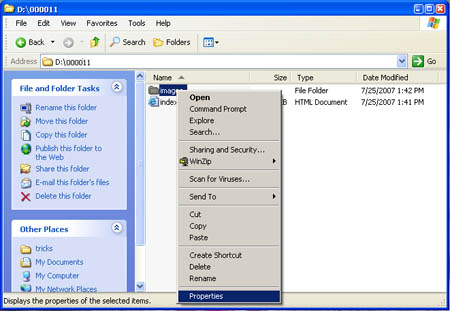
This tricks shows you how to setup any folder to display its contents as a photo folder. In many cases, you save your images/photos in a folder different than "My Pictures" (under "My Documents"). Since this folder you choose is just like any other normal folders, its contents displayed as a listing of files. You can temporary change it by just right-click and select "View" >> "Thumbnails". But if you want to change the folder so that everytime you come back, the folder itself, as well as all its subfolders, display the contents as photo thumbnails.
Here's How

  • Right-click on the folder you choose and select "Properties"


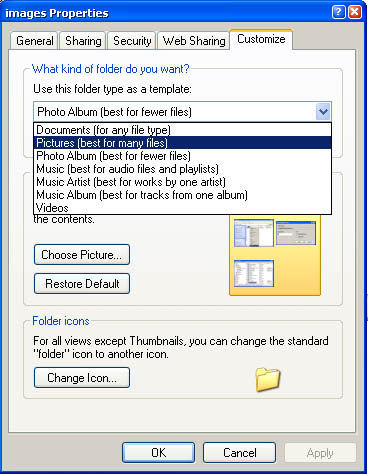
  • Select "Customize" Tab. Then under "Use this folder type as a template", select "Pictures (best for many files)"


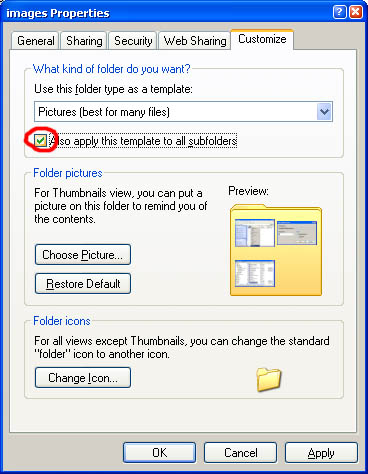
  • Check on "Also apply this template to all subfolders" to apply the setting to subfoders as well


  • Click OK to exit

  • Turn ON/OFF Num Lock on Startup


    Turn ON/OFF Num Lock on Startup


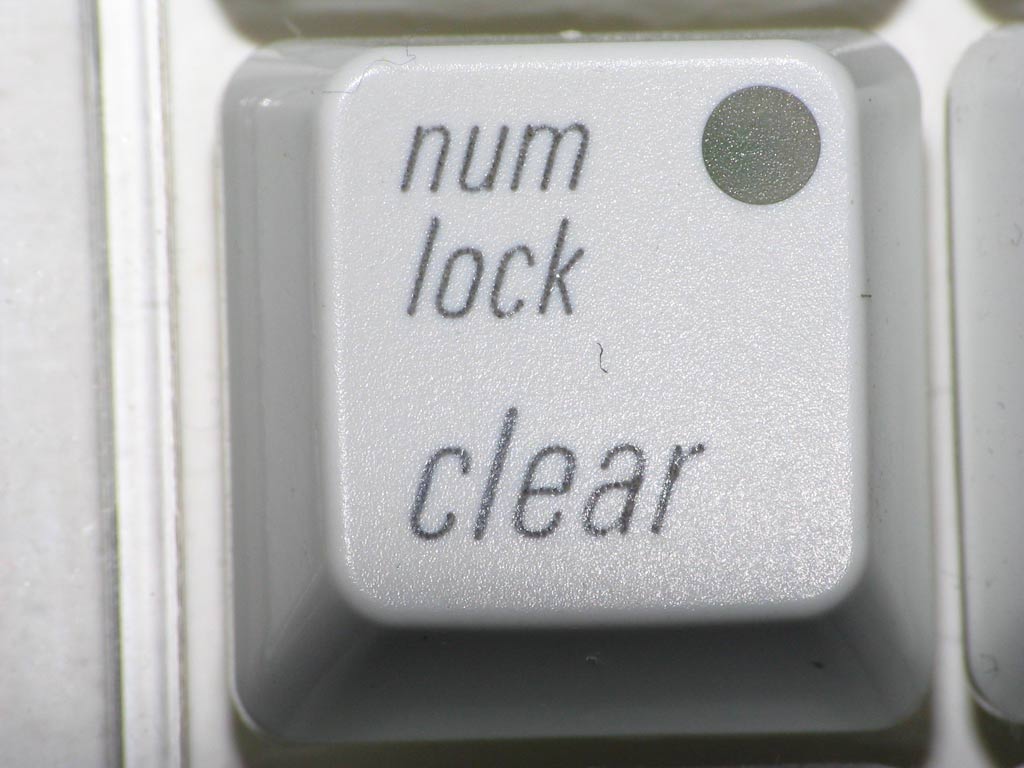
    Most of standard keyboards come with a small numeric keypad which identified by the numbers from 0 to 9. However, this numeric keypad is also served for some other functions such as "Page Up", "Page Down", "End", "Home", etc... depending on which mode of the "Num Lock" is being used. Many Windows users find this numeric keypad useful to type the numbers faster. But oopps... after hitting a several keys on the numeric keypad, you recognize the outcomes are not what you expected. Then you recognize the "Num Lock" mode is "OFF", so you just need to switch it on, and... start over your typing! The bad news is, by default, Windows turns the Num Lock off; however, the good news is, you can configure Windows to turn this Num Lock ON so that whenever you mean "number", you really get a number.
    Read on, you'll get the details how to set Windows to keep the Num Lock status "ON" as default. In fact, you will need to make a small change on your Windows Registry to turn the Num Lock ON everytime Windows starts up.
    IMPORTANT This article will guide to some steps to modify your Windows Registry. Stop if you're not familiar with the Windows Registry. Making a wrong change on the Windows Registry could cause critical problems to your computer.
    Proceed at your own risks
    This tip modifies the Windows Registry. So be aware and careful when following the steps. Damage the Windows Registry might damage your Windows.
    1. Open the "Registry Editor" ("Start" >> "Run", then type "regedit" and Enter).
    2. Expand to the following key:
      HKEY_CURRENT_USER\Control Panel\Keyboard\
    3. Within the keyboard folder, you should have a string value named "InitialKeyboardIndicators" with a value of 01, or 2.
    4. Double-click on this string value "InitialKeyboardIndicators" and edit the value to what you want. Below is the explaination of the values:
      0Num Lock is turned OFF on startup
      1Disable Num Lock
      2Num Lock is turned ON on startup

    Microsoft Windows Shortcut Keys


    Microsoft Windows Shortcut Keys


    This is a listing of some common shortcut keys in different versions Microsoft Windows.
    Some shortcut keys below are not supported in all versions of Windows.
    The shortcut keys on this page are only applicable for Windows in general, if you are looking for shortcut keys for a specific application (i.e. Excel, Word, etc..) please see the links at the bottom of this page.
    Use at your own risk.

    Shortcut KeySupported Window VersionsShort Key Description
    Alt + (double-click)95, 98, ME, NT, 2000, XP, VistaOpen Properties dialog of selected item.
    Alt + Enter95, 98, ME, NT, 2000, XP, VistaOpens properties window of selected item.
    Alt + Esc95, 98, ME, NT, 2000, XP, VistaSwitch Between open tasks available on the taskbar.
    Alt + F495, 98, ME, NT, 2000, XP, VistaClose the top (focused) window.
    Alt + Tab95, 98, ME, NT, 2000, XP, VistaSwitch between open windows.
    Alt + Tab + Shift95, 98, ME, NT, 2000, XP, VistaSwitch between open windows, backward.
    Ctrl + Alt + Delete (or Del)95, 98, ME, NT, 2000, XP, VistaBring up the Windows Task Manager, or reboot computer.
    Ctrl + Esc95, 98, ME, NT, 2000, XP, VistaBring up the Windows Start menu.
    Ctrl + '+' ('+' key on the keypad)98, ME, NT, 2000, XP, VistaAutofit the widths of all columns (if available) in current window.
    Ctrl + F495, 98, ME, NT, 2000, XP, VistaClose sub window/tab.
    Ctrl + Tab95, 98, ME, NT, 2000, XP, VistaSwitch between existing tabs (within a window).
    Ctrl + Tab + Shift95, 98, ME, NT, 2000, XP, VistaSwitch between existing tabs (within a window), backward
    F195, 98, ME, NT, 2000, XP, VistaOpen Help for Windows or focused application.
    F295, 98, ME, NT, 2000, XP, VistaRename.
    F395, 98, ME, NT, 2000, XP, VistaFind/Search.
    F495, 98, ME, NT, 2000, XP, VistaSelect drives or display the list of drives
    F595, 98, ME, NT, 2000, XP, VistaRefresh.
    F695, 98, ME, NT, 2000, XP, VistaSwitch focus to the address bar (if exists).
    F1095, 98, ME, NT, 2000, XP, VistaSwitch focus to the top menu bar.
    Shift + F1095, 98, ME, NT, 2000, XP, VistaSame as mouse right-click on the select item.
    Print Screen95, 98, ME, NT, 2000, XP, VistaCapture a screenshot of the entire desktop to clipboard.
    Print Screen + Alt95, 98, ME, NT, 2000, XP, VistaCapture a screenshot of just the top(focused) window to clipboard.
    Shift + Delete (or Del)95, 98, ME, NT, 2000, XP, VistaPermanently delete selected file(s)/folder(s) (bypass recycle bin)
    Shift (hold while inserting an audio CD to drive)95, 98, ME, NT, 2000, XP, VistaPrevent autoplay.
    * (keypad) on Windows Explorer.95, 98, ME, NT, 2000, XP, VistaExpand all sub-directories from the selected item.
    + (keypad) on Windows Explorer.95, 98, ME, NT, 2000, XP, VistaExpand only the first level of selected item.
    - (keypad) on Windows Explorer.95, 98, ME, NT, 2000, XP, VistaCollapse
    Most keyboards have a Windows Key (key with a Windows icon). This key provides additional shortcuts for Microsoft Windows. Below is a list of the shortcut keys by combining the Windows key and other keys.
    Shortcut KeysDescription
    WINDOWS-KEYBring up the Windows Start menu.
    WINDOWS-KEY + F1Bring up the Windows Help.
    WINDOWS-KEY + eOpen Microsoft Explorer.
    WINDOWS-KEY + fWindows Search.
    WINDOWS-KEY + Ctrl + fSearch for computers
    WINDOWS-KEY + dMinimizes all and bring up desktop, or restore all
    WINDOWS-KEY + lLock the computer (Windows XP & newer).
    WINDOWS-KEY + mMinimizes all windows.
    WINDOWS-KEY + Shift + MRestore all. Opposite with WINDOWS-KEY + M and WINDOWS-KEY + D.
    WINDOWS-KEY + rOpen the run window.
    WINDOWS-KEY + uUtility Manager.
    WINDOWS-KEY + TabCycle through the programs on task bar.
    WINDOWS-KEY + Pause/BreakOpen the System Properties window.

    Keyboard Shortcuts


    Basic PC Shortcut Keys


    The followings are some basic PC shortcut keys that are supported in most IBM compatible computers. They are also supported in most application software.
    Use at your own risk.
    Shortcut KeysSupported Window VersionsDescription
    Alt + e95, 98, ME, NT, 2000, XP, VistaPull down the top Edit menu.
    Alt + f95, 98, ME, NT, 2000, XP, VistaPull down the top File menu
    Ctrl + a95, 98, ME, NT, 2000, XP, VistaSelect all text.
    Ctrl + c95, 98, ME, NT, 2000, XP, VistaCopy selected item(s) (to clipboard).
    Ctrl + f95, 98, ME, NT, 2000, XP, VistaFind.
    Ctrl + v95, 98, ME, NT, 2000, XP, VistaPaste copied item(s) from clipboard
    Ctrl + x95, 98, ME, NT, 2000, XP, VistaCut.
    Ctrl + Ins95, 98, ME, NT, 2000, XP, VistaSame as Ctrl + c
    Ctrl + (left arrow)95, 98, ME, NT, 2000, XP, VistaMove one word to the left at a time.
    Ctrl + (right arrow)95, 98, ME, NT, 2000, XP, VistaMove one word to the right at a time.
    Shift + Ins95, 98, ME, NT, 2000, XP, VistaSame as Ctrl + v
    Shift + Delelte (or Del)95, 98, ME, NT, 2000, XP, VistaCut. Or permanently delete selected item(s) on Windows Explorer.
    F195, 98, ME, NT, 2000, XP, VistaHelp.
    Home95, 98, ME, NT, 2000, XP, VistaJump to the beginning of the line or page.
    Ctrl + Home95, 98, ME, NT, 2000, XP, VistaJump to the beginning of the document or page.
    End95, 98, ME, NT, 2000, XP, VistaJump to the end of the line or page.
    Ctrl + End95, 98, ME, NT, 2000, XP, Vistaump to the end of the document or page.
    Shift + Home95, 98, ME, NT, 2000, XP, VistaSet selection (highlight) from current position to beginning of the line or page.
    Shift + End95, 98, ME, NT, 2000, XP, VistaSet selection (highlight) from current position to end of the line or page.
    Shift + (left arrow)95, 98, ME, NT, 2000, XP, VistaSet selection (highlight) from current position to the left, one character at a time.
    Shift + (right arrow)95, 98, ME, NT, 2000, XP, VistaSet selection (highlight) from current position to the right, one character at a time.
    Shift + (down arrow)95, 98, ME, NT, 2000, XP, VistaSet selection (highlight) from current position to the next line down.
    Shift + (up arrow)95, 98, ME, NT, 2000, XP, VistaSet selection (highlight) from current position to the next line up.

    Windows XP Secrets


    COOL WINDOWS XP SECRETS


    Notepad Secrets
    Create a log
    1. Open Notepad
    2. On the very first line, type in ".LOG" (without quotes) then press Enter for a new line
    3. Now you can type in some text if you want, then save the file.
    4. Next time when you open the file, notice its contents. Notepad automatically adds a time/date log everytime you open the file.
    Text becomes unreadable
    1. Open Notepad
    2. On the very first line, type in "dont eat the donut" (without quotes) then save and close the file. Note: the file should have only one line of the text above.
    3. Now, open the same file. You'll notice the text becomes unreadable squares. (try this with different text with the same format and length).
    Paint Secrets
    Create a trail image
    1. Open Paint, then open an image.
    2. Right-click on the image and select "Select All"
    3. Now hold the "Shift" key and move the image around. The image will be drawn with trail.
    10x Zoom
    1. Open Paint, then open a small image.
    2. Select the zoom "Magnifier" tool.
    3. Windows Paint lists out the zoom options from 1x to 8x, but there is a 10x...
    4. After selecting the Magnifier tool, point the mouse right at the border line right under "8x" and left-click. There you go.. the hidden 10x.
    Other Secrets
    Where is the relaxing music that you've heard during Windows XP Installation?
    1. The file is in:
      C:\Windows\system32\oobe\images\title.wma
    Game Secrets
     Solitaire: Instant Win
    1. Press Alt + Shift + 2 to instantly win
     Solitaire: Draw only 1 card (instead of 3)
    1. Hold down Ctrl + Alt + Shift then click on unopen cards to draw.
     FreeCell: Instant Win
    1. Hold down Ctrl + Shift + F10 while playing, then click Abort.
    2. Now move one card.
     FreeCell: Hidden Game Modes
    1. Go to "Game" menu choose "Select Game"
    2. Here you can choose from game mode 1 to 1,000,000. But -1 and -2 will also work (hidden modes)
     Hearts: Show All Card
      Warning! this requires a modification on your registry. Be sure you follow the steps carefully. Damage your registry might damage your Windows.
    1. Open the "Registry Editor" by: "Start" >> "Run" then type "regedit" and press Enter
    2. Expand to HKEY_CURRENT_USER\Software\Microsoft\Windows\CurrentVersion\Applets\Hearts
    3. Right-click on the right panel and create a new String value with the name "ZB"
    4. Double-click to open this key "ZB" to edit its value. Then enter "42" and close the Registry Editor.
    5. Start Hearts and Press Ctrl + Alt + Shift + F12 to show all the cards
     Minesweeper: Stop The Timer
    1. When you start to play a new game, the timer is ticking...
    2. Press Windows Key + D to show desktop.
    3. Now come back to the game by selecting it from the taskbar. The timer is stopped.
     Pinball
    1. Unlimited Balls: Type bmax at a new game to get unlimited balls (no notification).
    2. Extra Balls: Type 1max at a new game to get extra balls.
    3. Gravity Well: Type gmax at a new game to activate Gravity Well.
    4. Promotion: Type rmax at a new game or while playing to get instant promotion and raising rank.
    5. Extra points with partial shots: Partially shot the ball just to pass the yellow light bars. There are 6 bars. With the first bar, you'll get 15,000 points, 2nd: 30,000,...
    6. Extra points with partial shots: Partially shot the ball just to pass the yellow light bars. There are 6 bars. With the first bar, you'll get 15,000 points, 2nd: 30,000,...
    7. Test Mode: Type hidden test with a new ball or new game. Now you can use your mouse to drag and move the ball where you want.

    Related Posts Plugin for WordPress, Blogger...